and on the drums …
Lucas Eldridge, who you may know from our time together in Small Miracles (he also did the amazing artwork for the band), is the drummer on the album. When I write the songs I often programme guide parts, but they really come alive when they’re handed over to a drummer and fellow songwriter. Lucas learned these parts in just a few weeks and tracked them all perfectly over 2 days in Kings Road Studio.
As I think about press releases and promoting the album, I keep returning to the question of genre. Most of the songs have origins in my voice and guitar, so folk or singer-songwriter feels like the easy choice. But the drumming infuses the songs with an intensity and dynamism that is much bigger than the intimate mixes we’re used to hearing with contemporary folk. I enjoy playing with tempo and dynamics, feeling the impact when the drums join a song that has otherwise just had soft guitars and keyboards in. The way live drums push and pull against the beat add a further colour to the mood and another layer that affects you subconsciously as you listen.
The best part is that Lucas is also a songwriter who thinks deeply and carefully about lyrics, arrangements, structure and meaning. Because these songs dealt with deeply personal and challenging lyrics, I needed someone who would tune into them and play in a way that respected the story being told.
Here are a few little snippets of Lucas in the studio. These will have to do for now, until you can hear the finished songs.
Tracking the intense, downbeat final chorus of Terminal One:
A tea towel in the hi-hats to deaden the sound for Cold Air, a track which matches a laid back hip-hop groove with finger-picked jazzy chords:
Some isolated cymbal swells to be dropped in at transitional moments:
home studio & studio studio
3 out of 12 songs for the debut album have now had their first mix at King’s Road Studios. At this point I’ll write a bit about the process of recording and how I’ve balanced recording at home and working in the ‘real’ studio with Sanders.
All of the songs on the album have elements that were originally recorded at home as part of the demos I make when I work on a song. Creating an arrangement that I can walk around and listen to really helps me examine a song and how effective it is. It’s one thing to imagine that you will have a saxophone solo in a track, but another to actually score out the notes and experience what it feels like when it comes in.
I enjoy being able to dip in and out of the songs when I’m at home. I’ve never been swayed by cosmic/supernatural/mythical narratives about songwriting being a form a divine energy that we channel. For me it is an everyday act. Some days I wake up with an idea in my head and stumbling to the keyboard to figure it out and capture it before it fades. Other times I’m tweaking a mix and finalising takes in between cooking dinner. I like that the songs get formed and chipped away at in such a mundane space. I want the songs to become a part of other people’s lives, not sacred objects that only get heard on stage or in a reverential silence.
Home Studio
I recorded a lot of the parts at home first. This is useful because I can take all the time I need to rehearse and record a variety of takes. Being able to record and review the takes at my own pace and not worry about the clock in the studio has really valuable. It’s also helped with the mixing, because I feel a lot more confident that the file being mixed in the studio studio is one that I am happy with.
Guitars
The acoustic, electric, mandolin and bass will get tracked live, usually with just one mic on DI into my computer.
Keyboards
As I don’t have the luxury of a Wurlitzer, Fender Rhodes or a real piano at home, I play in keyboard parts with my MIDI keyboard. I resist using the quantize function to tidy up the playing (unless it’s a really big mistake …).
Percussion
Most percussion is also tracked at home, with the exception of the difficult/fast parts which I let Sanders track at the studio.
Studio Studio
Vocals at usw
In the end there’s about a 60/40 split with the vocals. Some of the parts really benefited from being sung in a big room, so Finn helped me out by engineering those sessions and helping me pick different microphones to create contrast between the big, open songs and the intimate, personal ones. We also captured lots of vocal doubles in these sessions which are great for making a chorus sound and feel bigger and more exciting.
I tracked a lot of the more wordy and intricate parts at home because this let me take more time when I wanted to be very precise about inflection and phrasing. I can be particularly picky about the vocals and a different take can have a huge difference on the feel of a song.
Drums and Re-Amping at KRS
The full, live drums on the album are all tracked by the brilliant songwriter and drummer Lucas Eldridge and unsurprisingly we needed the full studio and 11 mics to capture everything. After we got the drums, we brought in the files that had been recorded at home and then ‘juiced them up.’ We do this by playing the audio file of my performance out of the studio desk and into an amplifier, EQ or compressor. We then re-record the sound after it’s been through the studio equipment. For me the files end up with a lot more presence and character after they’ve been through this process. They feel like the coloured in version, not just the sketch.
Pat of being an independent musician in 2026 is having to self-finance, manage limited time and money. I really recommend this split approach between home and studio if you’re looking to record your first album.
Album one: september
Recording is complete. Mixing is underway. 3 songs down, 9 to go.
The third track we worked on is Whoever We Wanted To Be. In contrast with the first two, this is the densest arrangement on the entire album. Mandolin, acoustic guitar, Wurlitzer, electric guitars, agogo bells, live drums, tambourine, synths, shimmery reverse effects, backing vocal stacks … it’s all in there, so we thought having this track completed would mean we had a starting point for the various moments where these instruments popup in the other songs.
The most interesting part of mixing is how you can use it to help reinforce the story of a song. Different instruments can be given prominence in certain sections or the drums can be made to feel closer or further away: all of this can feed into whether the mix creates a stable or unsettled, dreamy or grounded atmosphere at various moments.
Some songs have been living in my head for over 3 years at this point, so it’s refreshing to have Sanders’ ideas on the mix and it can help me refocus and let new aspects of the arrangement get a moment in the spotlight.
We’ve got a busy October mixing another 5 songs. I’m editing some fun samples from a Jazz coffee shop in Barry (Coaltrains) that will feature in the most experimental track on the album. I’ll post more updates as they happen. It’s exciting to get closer to the release date when people will start hearing all of this music.
Mixing has begun on the album and the first two tracks featured vocals recorded on this ribbon mic. It’s particularly effective when singing a dynamic vocal that needs you to come closer to the mic for quieter, low moments, but it also handles loud, rising notes with a wonderful smoothness. Hearing myself through a mic like this really helps me relax and feel more confident about the take I’m recording.
On that note: everything has been recorded now! I’ve received a couple of sublime guest contributions in the form of sound design and orchestration from Freyja Elsy and a precise, poignant haiku from Rachel Helena Walsh. I’ll write in detail on these when the song they feature on has been mixed.
We decided to mix the two simplest songs first. The tracks Don’t Mention It and Prague are both comprised mostly of acoustic guitar and a single lead vocal. The songs are the centrepiece and the closer of the album, so it felt good to have a sense of how those key points in the record would feel at an early stage.
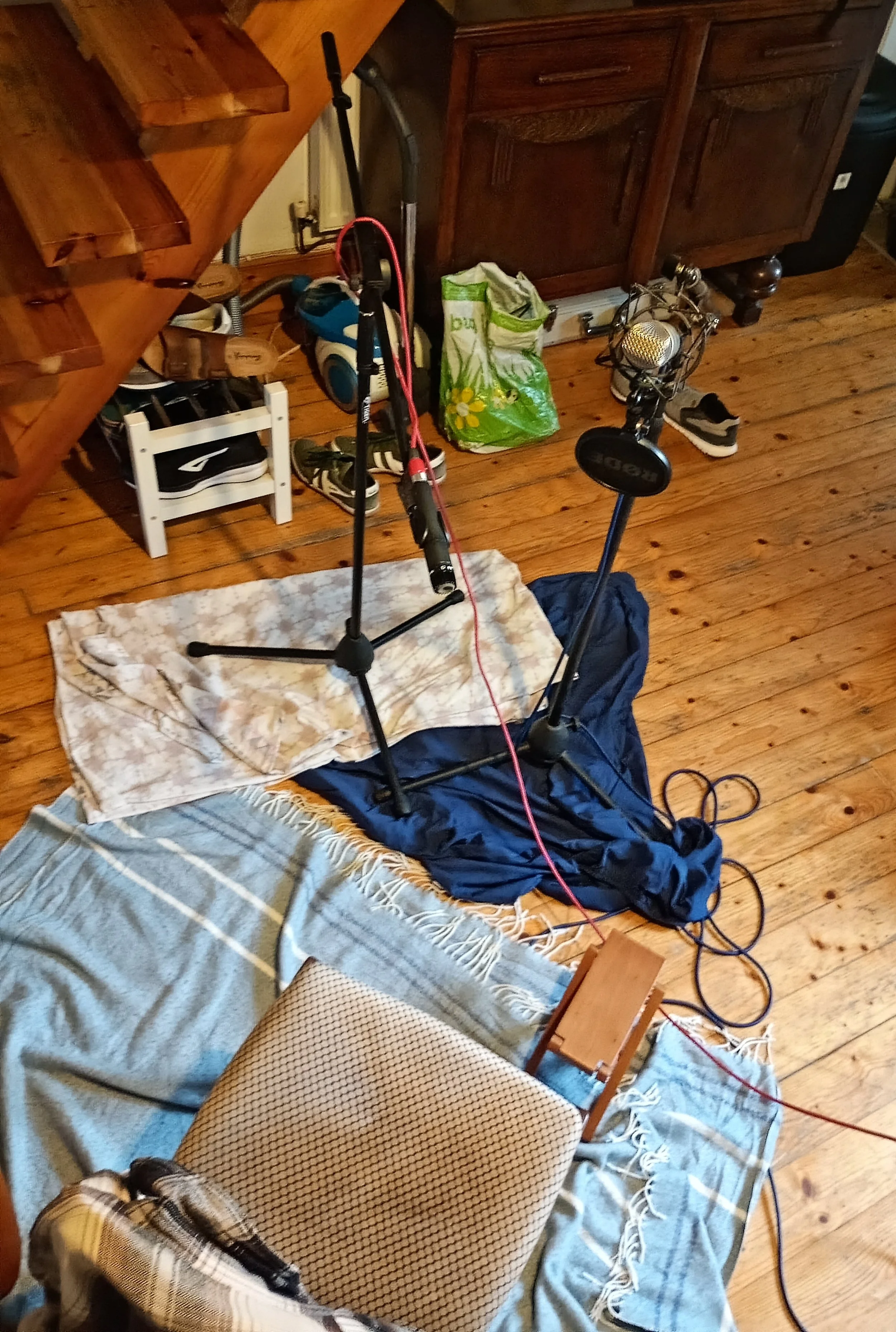
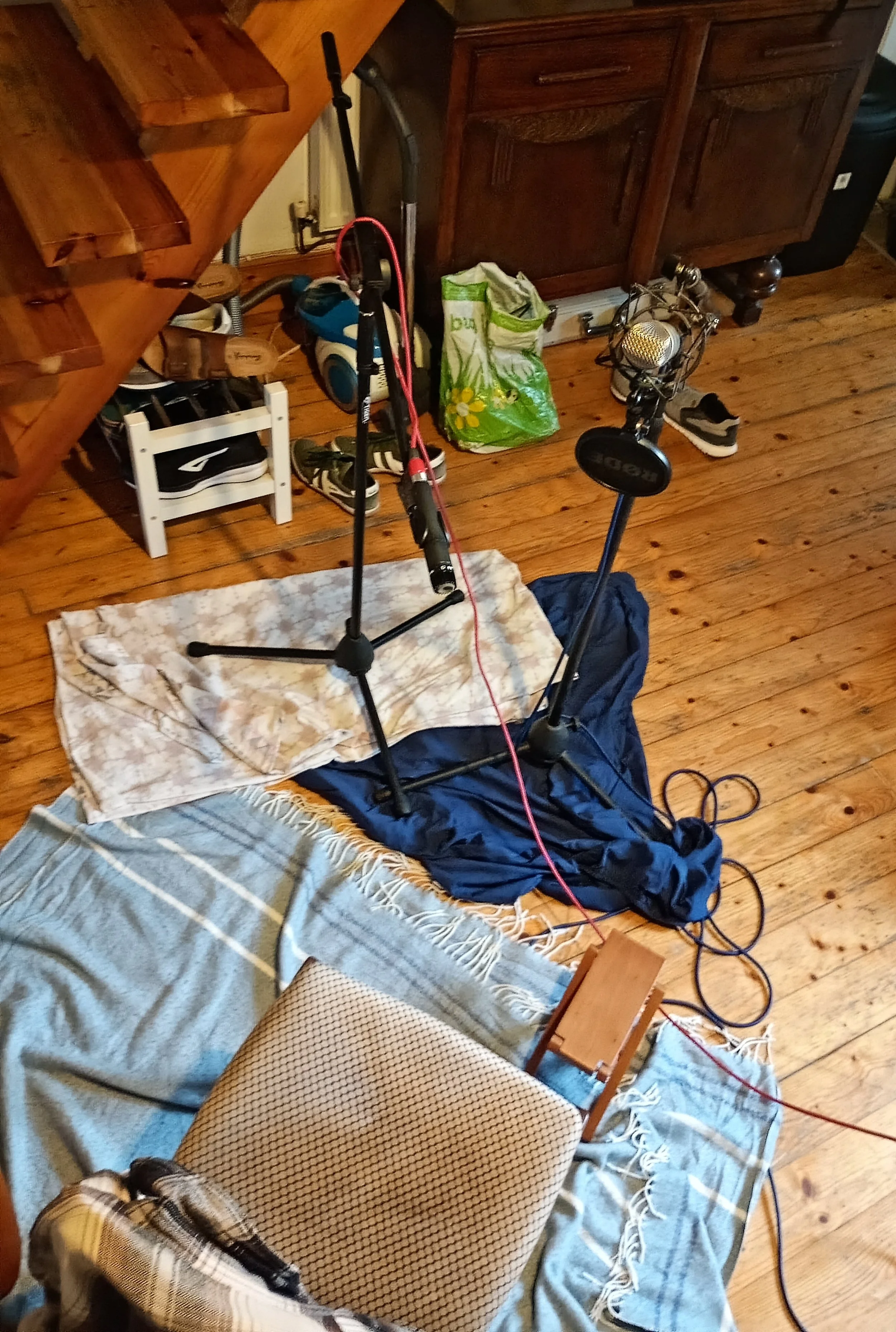
Before we started mixing those tracks, however, we ran all of the vocals and acoustic guitars through the outboard compressors, amps and EQ racks at King’s Road Studio. This helped give the tracks a bit more presence and character, as well as imbuing them with a consistent audio quality that helps the album have a consistent sonic palette. Many of the guitars and vocals were recorded at home (see photo below), so adding some analogue studio layers after the fact gives them a finish that helps them feel more detailed and professional.

Album one: August
Recording is 90% complete. It’s almost time to mix
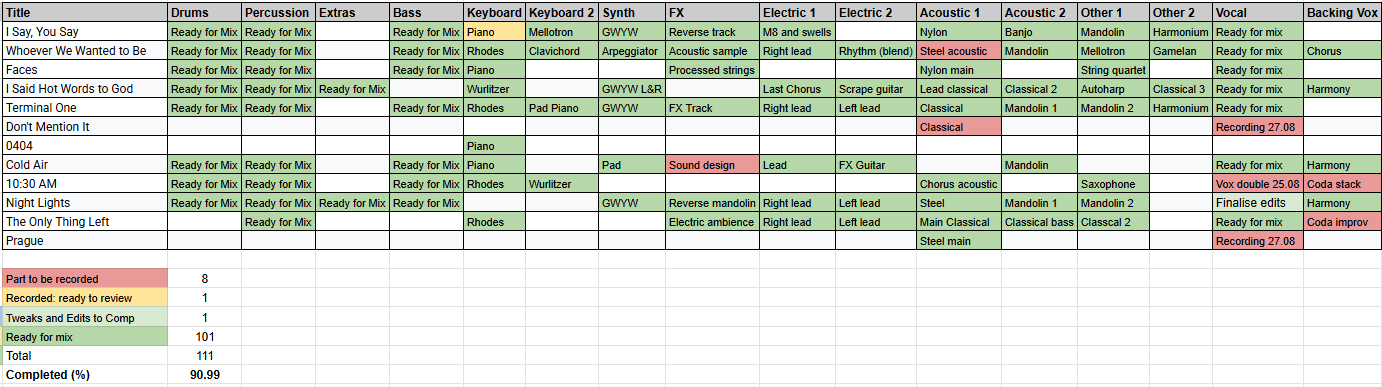
It’s official, the spreadsheet says the album is 90% recorded. I had to move my planning out of a notebook and onto a screen as the amount of elements in each track grew. I find it helpful to colour-code the progress. It makes it easier for me to identify what to do next when I have a spare evening to chip away at another tasks.
At this point there are a few vocals, guest spots and a couple of guitar parts left to record in their final form. All of these parts already exist in the demos I made when planning the album. In some cases the demo take holds up over time and gets carried forward into the main project. This is common with the guitar parts and the programmed synths. Vocals tend to evolve the most. As I live with a song and perform it at open mics and gigs I get more comfortable with the melody and phrasing and tend to find new moments of expression or variation that work their way into the final version.
Mixing sessions have been booked at King’s Road Studios for the autumn, so now there is a bit of pressure to get the final parts in place. I’ve been recording vocals with Finn (of Small Miracles) and at home. Finn is great at coaching me into an expressive vocal take, especially when I need to open up my lungs and sing loud. One of the downsides of home recording is that you naturally limit your voice because you’re in a smaller room and their are neighbours on the other side of the wall. Some melodies and lyrics deserve to be belted. There’s also something to be said for ‘performing’ a take in front of an audience, even if it’s just one person. Finn is a very engaged listener: recording Cold Air and seeing their reaction through the window to the control room gave me confidence in how I was approaching the song and working with the mic. I hope you’ll hear all of this when the song is finally finished!
Other songs, however, required alone time and obsessive focus on the tiniest details. I prefer to do this at home because I don’t have to make anybody else suffer whilst I compare 5 different versions of the same line until I land on the one that feels right.
I’ve no idea how other artists plan their recording sessions, but since working on my Master’s back in 2020 I always find it easier to have a demo for the arrangement then translate the arrangement into a to-do list and a table. Watching the various tasks get relabelled (and coloured) from ‘to be recorded’ to ‘ready to mix’ gives me lots of ongoing reasons to feel positive and accomplished. It could be overwhelming to some to see the list of over 100 parts to begin with, but for me it’s much more manageable to have them laid out. I can look at the list and see which parts match my mood on a given day and then jump to those ones during a session.
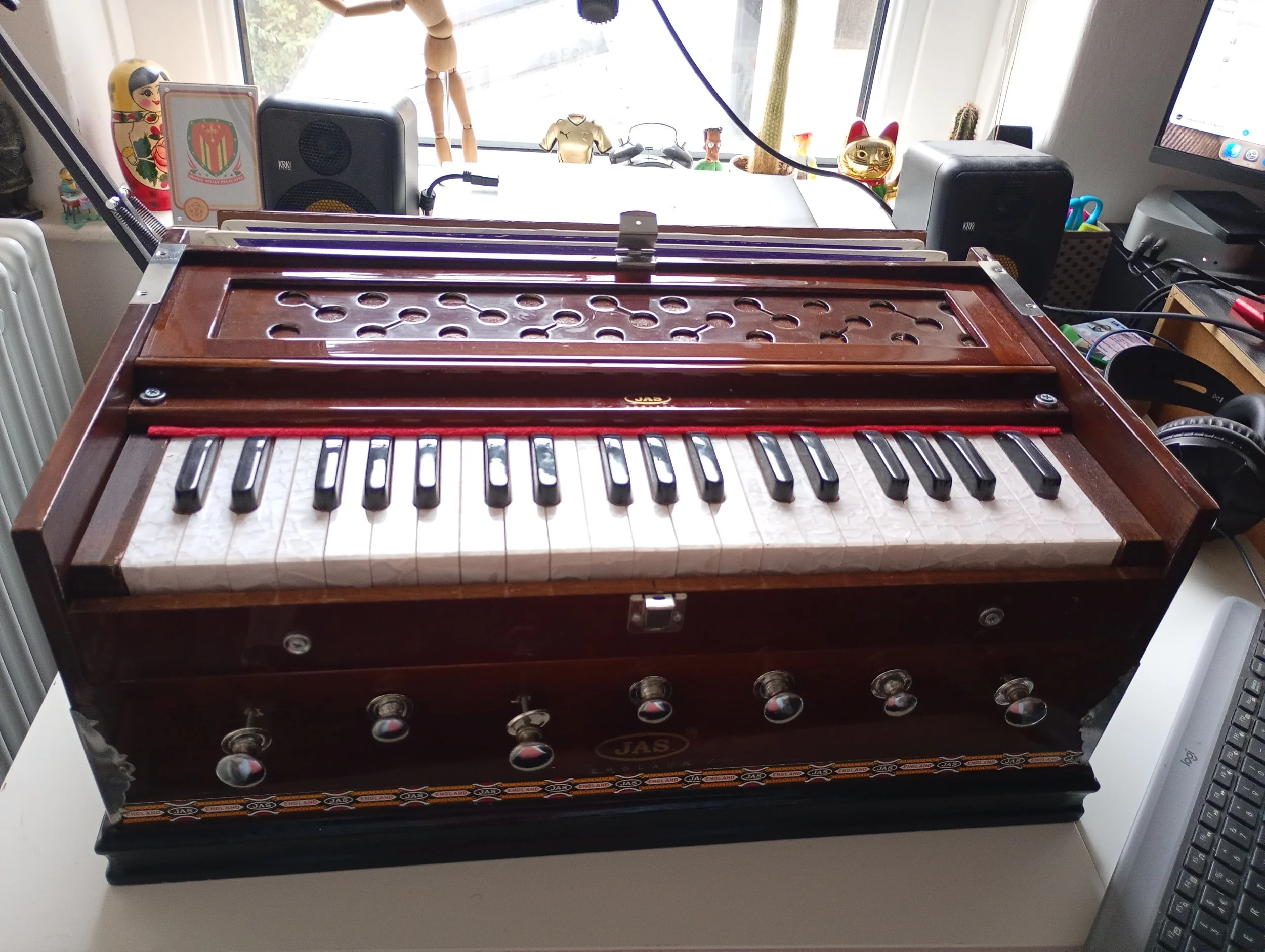
A late addition has been some harmonium. The opening track has lots of lovely arpeggiated mandolin and banjo, alongside a swung acoustic guitar and bass part, making it very lively. There were moments when it felt so busy that the song needed something to glue it together. Luckily, my good friend and long-time collaborator Jon recently bought a harmonium and let me record some parts with him. After tracking for I Say, You Say, we also captured some additional chords to work as transitions between songs in related keys.
These ideas mostly come about because I have demo-ed the album in advance and can walk around listening to it and consider the tracklisting. I wanted to make sure the tracks flowed in terms of the narrative, but also the harmony and the relationship between the keys of each track. Whether that’s one song ending on F and another safely starting there, or a chromatic shift from Eb minor to D minor that creates instability between and end a start … it all adds to the mood.
I’ll update again at the end of the month when the mixing has begun.

Another Life
Thoughts on collaborative networks in music writing, recording and how musical culture is strengthened when we work with other people (even if it takes much longer than using artificial alternatives)
The final single from Freyja Elysy’s upcoming EP ‘To Stop The World Turning’ is Another Life and it was released last week. Have a listen above whilst you read.
When Freyja first showed me Another Life she had written a comprehensive guitar part for most of the song. I listened to a demo with MIDI version of the guitar and played along with the score. It’s an interesting challenge when somebody writes for another instrument. Freyja plays piano more than guitar, so her instincts lead to chord shapes that are not immediate on the guitar! I lenjoyed being pushed to memorise new movements. It reminded me of the freshness of the early years when I was learning guitar.
The song also features double-bass (Richard F. Jackson), drums (Zach Breskal), violin (Non Morgan) and cello (Kirsten Miller). Freyja scored all of these parts in advance and produce a version of the song with plug-ins that simulate the sound of the all the instruments. Freyja then worked with us to refine the parts and play them for real in a way that made sense to us as musicians. It also lets us add expression, dynamics, tone, humanity and imperfections.
Many non-musicians (or non-music geeks) might not be able to tell the different between MIDI instruments and the live alternatives if they heard them in a mix side-by-side. The most advanced software is able to use audio samples in a way which makes the distinction even harder to distinguish. AI is speeding up this process and could even assist a human in writing the parts in the first place.
I am glad Freyja chose the slower, more complicated and more human path of finding collaborators. She reached out to musicians she knew and applied for funding that would allow her to access a professional recording studio and expand the scope of her songs and productions. A network of musicians were connected by the arrangement, the recording and now the finished piece of art: the song that we are all a part of. Freyja devoted many hours to the mixing process to bring a complex arrangement into a cohesive whole.
The song is now in its second week on the BBC Radio Wales A list. This means it will be played on primetime radio shows across Wales and thousands of new listeners will hear the song. I think if Freyja had taken the easy route, asked AI to churn out an arrangement, run it through some plugins, got an AI mastering engineer (instead of seasoned pro Charlie Francis), not bothered to hire Owain at Studiowz, but just used AI to generate drum tracks and guitar tones … well, the song would still exist. It would not have sounded as moving, effective or human as it does. And I doubt it would have ended up on the radio alongside so many other great performances and recordings.

control
Reflections on Control, the second single from Freyja Elsy’s upcoming ‘to stop the world turning’ EP.
I was drafting this post about Control when I had the good luck to listen to Adam Walton give the song its premiere on BBC Radio Wales. I’d been struggling to sum up the mood, but he did it perfectly: “What an elevating slow burn this is. Sumptuously produced."

The big trees
Muddy and crunchy in all the right ways
Control is the second song from Freyja’s upcoming EP ‘to stop the world turning’. You can listen to Control everywhere from 3rd July.
We worked together on the EP at StudiOwz last summer. Freyja had mentioned there was an extra song floating around, in case we had spare time, but I didn’t actually hear Control in full until the time came to write and record a part for it. Freyja, Richard and Zach had tracked their parts the day before, so my first listen was on the studio monitors with freshly recorded double-bass, grand piano and drums. I was immediately hooked on sparse groove and how it played against the the ear worm of the chorus (which loops and lingers just like the anxiety being evoked in the lyric). I improvised as the track played and found a couple of motifs that sat well in the spaces between the phrases.
One of my favourite parts about collaborating in a studio is how quickly new sounds come together. I had one more playthrough to hone my ideas Freyja and Owain dialled in the pedals to create an underwater, fuzzy tone that had a feeling of isolation and disassociation. Within 10 minutes I’d gone from never having heard the song to being ready to record. People are sometimes surprised at how quickly music comes together (the recent Beatles documentary showing the creation of Get Back being a case in point). To me it makes perfect sense. When musicians get to be in a studio where there only task is to think, write and speak music, it’s natural for it all to happen faster. Just like how learning a second language is quicker if you immerse yourself in it.

the watkins copicat
echo, sustain & atmosphere
In the end I think we captured 2 full takes, which Freyja took away for mixing. Along the way she sent me rough mixes and the part got sculpted as we discussed which parts to cut or push forward at certain moments. In my own songs I usually find there is a moment where something has to be removed from the mix. We did this in the final verse and it gave the space needed for the lyrics, but also created more impact when the guitar returned.
I’m excited for everyone to hear the finished song. When I had access to the preview links (perk of being on the track!) I would reach the end of the EP and then loop Control on repeat. Every listen revealed more nuances in the depths of the production. “Ghosts appear and fade away” to quote a lyric from another song about anxiety: Overkill by Men at Work. Yes it’s a very different vibe, but who can resist the sax and the octave leap in the third verse! To close I’ll return to Adam’s words. Although the song focuses on the dark, heavy, sometimes relentless impact of anxiety, it does feel uplifting to me. Taking turmoil that can control you and sculpting it in a song for the sake of self-expression and beauty is a sublime act of elevation. I am grateful to have played my part in it.

In My Veins
“The lyrics evoke the way in which snatches of memory move in and out of focus as we age, grow and reflect on our lives; a fluid, dynamic arrangement made perfect sense. Freyja’s mix did an excellent job of drawing the ear to the shifting elements. In the ‘are you reaching out’ section my mind goes between the vocal, the guitar motif and the swirling snatches of glitchy voices that sound like flashbacks to a dream that catch you as you’re waking up.”

The first single from Freyja Elsy’s upcoming EP ‘To Stop The World Turning’ is out today. Have a listen to ‘In My Veins’ while you ready my memories of collaborating on it.
I first worked on this song with Freyja preparing a live version for her first headline show back in April 2025. The chiming guitar riff came from a keyboard idea Freyja had written years before. Some electric pianos let you record and store ideas on them. Freyja rediscovered this motif and brought it to the song as a guitar part.
Later that year we headed to StudiOwz in West Wales to record the track along with the rest of the EP. You can read about the sessions from Freyja’s POV at her website
Going into the session I knew we would the main guitar part with a bright, chiming, chorus tone. It offers a counterpoint to the tension in the sparse piano and double-bass and fills the gaps of reflection when the vocal drops out. The great thing about being in the studio is people end up in ideas mode. Owain Jenkins (engineer and owner of StudOwz) suggested doubling the guitar part with a random guitar he had lying about. He had restrung it so of the strings covering 2 ascending octaves they all sat in a range of 1 octave. It made the notes and resonant frequencies cluster together and a added a lovely, vibrant harpsicord-esque shimmer which sits in the left headphone.
After that we added some driving acoustic guitar to reinforce the folk side of the folktronica aim. Freyja took the lead in guiding me about when the make the rhythm busier and when to just let the chords ring, creating contrast in the different verses and choruses. As an arranger this is one of my favourite, simple tricks in songs. Variation instead of straightforward repetition can add tension and release and also help reinforce the shift in lyrical mood as the song develops.
The lyrics evoke the way in which snatches of memory move in and out of focus as we age, grow and reflect on our lives; a fluid, dynamic arrangement made perfect sense. Freyja’s mix did an excellent job of drawing the ear to the shifting elements. In the ‘are you reaching out’ section my mind goes between the vocal, the guitar motif and the swirling snatches of glitchy voices that sound like flashbacks to a dream that catch you as you’re waking up.
I hope you enjoy listening to the song and stay tuned for the next release from the EP.

album one - june update
The songs have been finished, lyrics finalised, demos made. Now I’m in the midst of recording the final parts, reviewing the takes and getting ready for mixing.
Some of the songs started life back in 2019 when I was completing my Master’s in Songwriting and Production at the University of South Wales. We were given endless prompts, tasks and challenges and every time I picked up an instrument, sat down with a notepad or just found myself with a moment alone and idea would pop into my head.
As I finalise the songs I’ll go into more detail about the process and the meaning.
For now, I want to thank Andrew Sanders at King’s Road Studios for his help with the core sessions. He very much took the lead in capturing excellent takes by Lucas Eldridge which helped the songs feel so much more alive and vibrant. Sanders also added plenty of tambourine, shaker and cabasa. As a drummer it takes him a lot less time than me to lock into a tempo and find the right rhythm to compliment a drum part.
We also re-amped the bass and keyboard parts. This gave them so much more character, as they had been initially recorded at home straight into my computer or using plugins. Sending the signals back out into amps then recording them with a mic responding in real time to air being moved, then sending those signals back in through rack compressors and EQs, it added the colour and tone that was missing from the demos.
The vocals have been tracked in two ways. Sessions at USW with Finn (of Small Miracles) were great for the parts where I needed to open up and sing loud. Finn is a great coach for this as a big, bold, performative singer. Having them gesturing and responding from the control room really helped me instil a live energy to the big choruses on the album. Some of the mic choices also brought out the necessary breathiness in chilly songs like Cold Air.
However, I found it more effective to track the most emotional and personal lyrics at home. I could take and re-take a line repeatedly without worrying about using another person’s time and energy, getting the phrasing just how I needed it to be.
There are two songs left to track, which we plan to capture as live takes. I’ll play guitar and sing simultaneously, capture a few options and pick the one that feels best.
Beyond that, some ear candy has been commissioned from Freyja Elsy and Jim Webster will be adding banjo to the opener then, I think I’ll be ready to mix.


sunken treasure
On my last day in Prague I squeezed in more sightseeing. Crossed the Charles Bridge and rubbed the lucky gold dog. Made a wish for your health. You only learned my middle name was Charles when we discussed the bridge that very week. Clearly we'd been busy with deeper discoveries in the eight and a half years beforehand.
So many messages. Countless thoughts back and forth up until I boarded. Memories. Difficult discussions about sharing (or hiding) your illness. Caring confrontations which ultimately helped me comfort important people when they needed it most.
I sent you clips of the final song we worked on. It started as a prayer for your life after recovery, but (months later) turned into a fantasy about the life you were never able to return to. Of course you questioned my eccentric arrangement. Of course you preferred the simple voice note recorded on just an acoustic guitar. I will share both versions one day: for both of us.
Bizarrely, whilst waiting in the departure lounge, I recognised a woman who I usually saw on my commute in South Wales: one of those people who stands out for no discernible reason. I knew it was her from the back of her head alone. Marshall headphones. Wispy hair. Autumn-coloured clothes. I walked around to confirm and told you all about it. How could she be here catching the same flight from Prague to the UK as me when we usually sit on the same train from Barry to Cardiff? It probably meant nothing, but I trusted you enough to share it and not feel like I was mad for noticing.
Fundamentally, love is a declaration that you like and accept what you know about someone and want to know more. You want to keep delving into the interesting, esoteric, complicated and simple details.
Grief forces this to stop in the most horrific way. You can only learn by looking into the past or using your imagination. Returning to old photos. Reading messages. Replaying memories in your mind. You have to abandon visions of the future that you didn't even realise existed. Nothing new feels fully real. Sunken treasure.
Originally posted on 26th January 2024

travel
I won't lie and pretend that I always felt this way about travelling.
Sometimes the distance made me nervous. Often the lack of a fully-formed plan made me protective (but later we indulged with silly beauty in this energy: getting lost and soaking in flooded fields because you were sure you'd seen some people ramble there from a passing bus once or twice. That was the plan, along with me knowing which direction East was). Occasionally a nervous voice from my inner child would question if you were leaving to escape me. But time and reflection and observation and honest conversation taught me that the person travelling does so for their own reasons.
Even if the reason is to put distance between themselves and you, it's not your job to stop them. If they want or need or are curious to find out what that feels like, to know how they are apart from you, in a new place (geographically, emotionally, spiritually) then love shouldn't stop them. Love should free them to do this. Love should let their friends, families and partners support them in their leaving.
And sometimes, of course, the only motive is pure exploration. "I don't know: let's find out."
I spent my 5th day in Prague exploring. The castle. The old town. Art shops. Alleyways. Some places you planned for us but ultimately couldn't make it to (somehow easier to admit after we had seen each other). Cakes like chocolate architecture. Coffee flights with quizzes to guess the farm from the flavour. A sketch of your colleague Saša. Restaurace "u Veverky" pretending to sell barbecued squirrels. A vintage shop with a school uniform from Conwy on a mannequin in the window. Cathedral. God is Gay graffiti right outside. Bright Jazz. Warm basement. Pickled camembert. TV tower. Dark cocktails. Cold hands. Warm skin.
"It's so nice not to be worrying about time or work." I told you.
Living with myself I realised many of the mistakes I had made. And I got to discover that you (and other wonderful people who are still here) loved me despite them.
Originally posted on 25th January 2024


