Album one: August
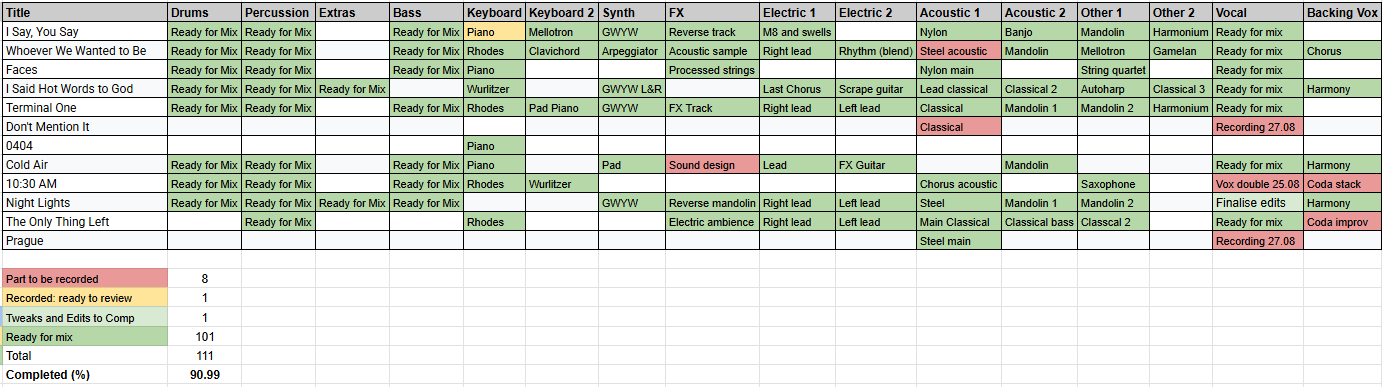
It’s official, the spreadsheet says the album is 90% recorded. I had to move my planning out of a notebook and onto a screen as the amount of elements in each track grew. I find it helpful to colour-code the progress. It makes it easier for me to identify what to do next when I have a spare evening to chip away at another tasks.
At this point there are a few vocals, guest spots and a couple of guitar parts left to record in their final form. All of these parts already exist in the demos I made when planning the album. In some cases the demo take holds up over time and gets carried forward into the main project. This is common with the guitar parts and the programmed synths. Vocals tend to evolve the most. As I live with a song and perform it at open mics and gigs I get more comfortable with the melody and phrasing and tend to find new moments of expression or variation that work their way into the final version.
Mixing sessions have been booked at King’s Road Studios for the autumn, so now there is a bit of pressure to get the final parts in place. I’ve been recording vocals with Finn (of Small Miracles) and at home. Finn is great at coaching me into an expressive vocal take, especially when I need to open up my lungs and sing loud. One of the downsides of home recording is that you naturally limit your voice because you’re in a smaller room and their are neighbours on the other side of the wall. Some melodies and lyrics deserve to be belted. There’s also something to be said for ‘performing’ a take in front of an audience, even if it’s just one person. Finn is a very engaged listener: recording Cold Air and seeing their reaction through the window to the control room gave me confidence in how I was approaching the song and working with the mic. I hope you’ll hear all of this when the song is finally finished!
Other songs, however, required alone time and obsessive focus on the tiniest details. I prefer to do this at home because I don’t have to make anybody else suffer whilst I compare 5 different versions of the same line until I land on the one that feels right.
I’ve no idea how other artists plan their recording sessions, but since working on my Master’s back in 2020 I always find it easier to have a demo for the arrangement then translate the arrangement into a to-do list and a table. Watching the various tasks get relabelled (and coloured) from ‘to be recorded’ to ‘ready to mix’ gives me lots of ongoing reasons to feel positive and accomplished. It could be overwhelming to some to see the list of over 100 parts to begin with, but for me it’s much more manageable to have them laid out. I can look at the list and see which parts match my mood on a given day and then jump to those ones during a session.
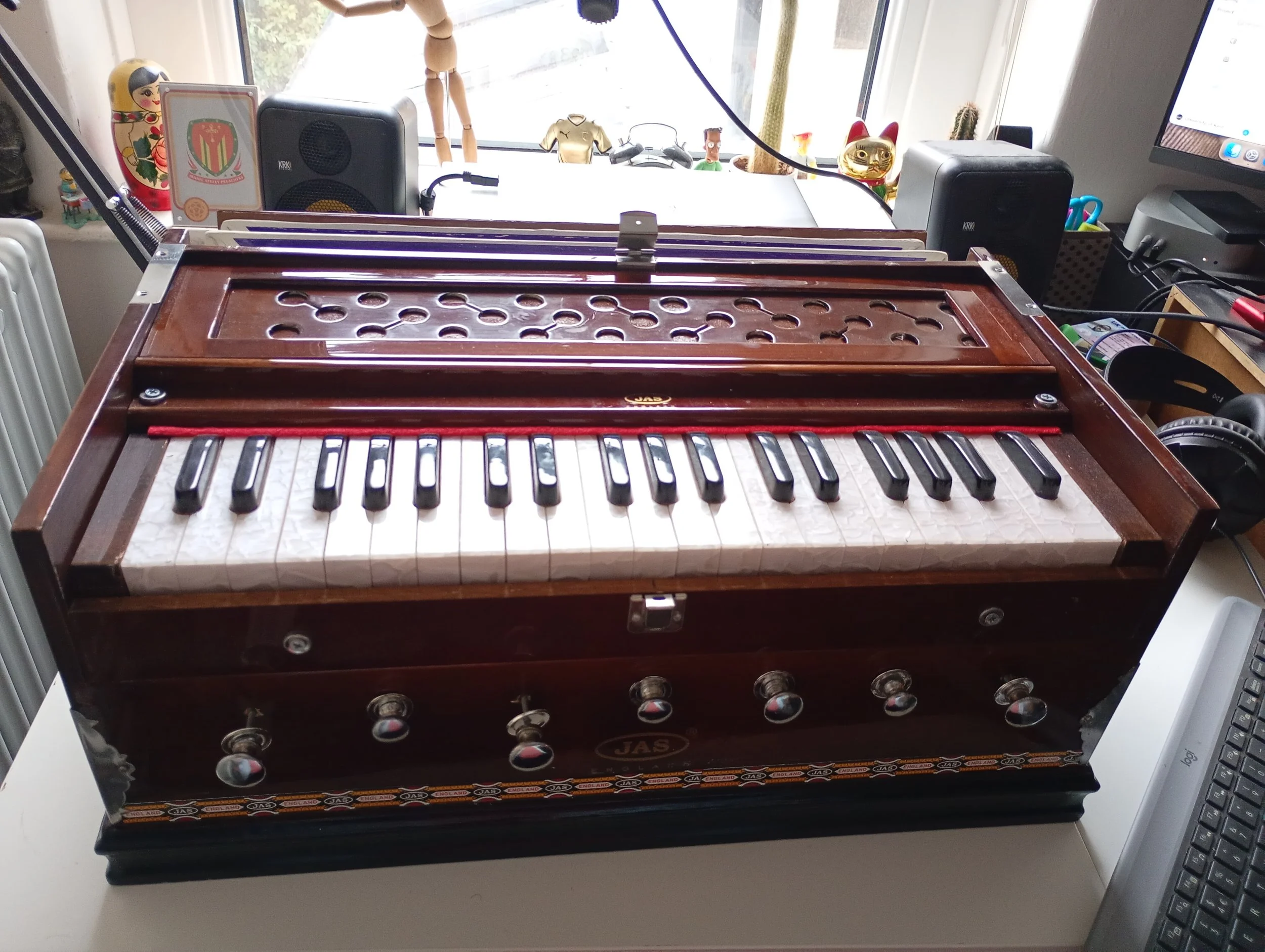
A late addition has been some harmonium. The opening track has lots of lovely arpeggiated mandolin and banjo, alongside a swung acoustic guitar and bass part, making it very lively. There were moments when it felt so busy that the song needed something to glue it together. Luckily, my good friend and long-time collaborator Jon recently bought a harmonium and let me record some parts with him. After tracking for I Say, You Say, we also captured some additional chords to work as transitions between songs in related keys.
These ideas mostly come about because I have demo-ed the album in advance and can walk around listening to it and consider the tracklisting. I wanted to make sure the tracks flowed in terms of the narrative, but also the harmony and the relationship between the keys of each track. Whether that’s one song ending on F and another safely starting there, or a chromatic shift from Eb minor to D minor that creates instability between and end a start … it all adds to the mood.
I’ll update again at the end of the month when the mixing has begun.